
CMRR
Center for Magnetic Resonance Research, Department of Radiology
Faculty and Staff
You are here
Michael Garwood, Ph.D.
|
|
|
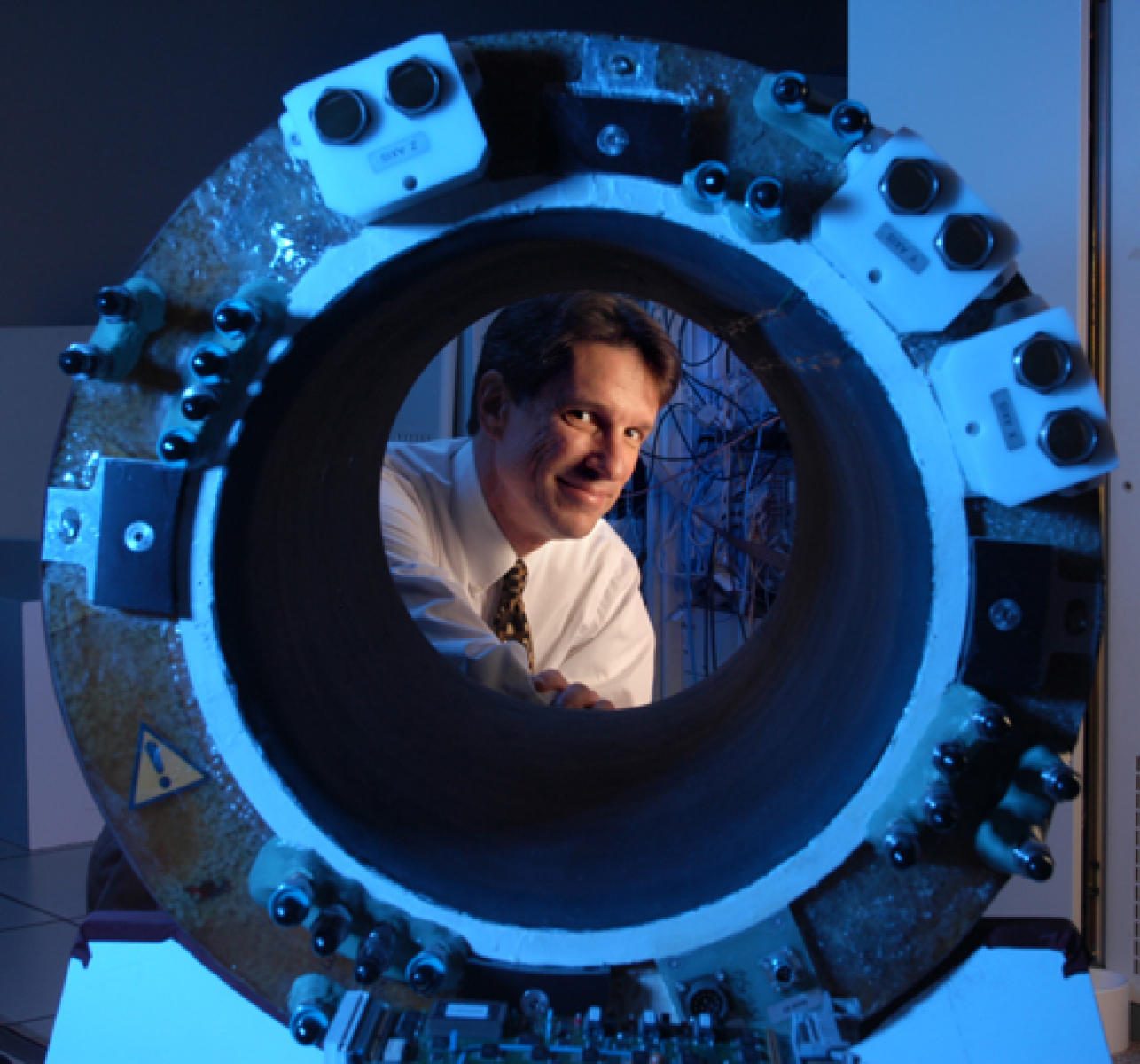
I am the principal investigator on a recently awarded $10,800,000 NIH grant that forms the basis of the research focus in my laboratory for the next 5 years. Specifically, I will lead the pursuit of a next generation neuroimaging platform based on magnetic resonance imaging (MRI). This first-of-its-kind MRI system will provide new frontiers for human brain research, particularly in terms of better understanding human behavior and motor coordination. For several years, I have had a focus on finding a way to create a small, portable MRI scanner for human brain research which would allow the subject’s body from the shoulders down to remain outside the magnet bore. Now, the culmination of multiple technical innovations from our laboratory and others brings this dream within grasp. The MRI technology called STEREO (for STEering REsonance over the Object), which makes this revolutionary new MRI scanner possible, recently originated in my laboratory after decades of research and breakthroughs in our understanding of frequency-modulated (FM) pulses and spatiotemporal encoding. For the past decade, I have had a focus on spatiotemporal encoding as a means to overcome a significant limitation of MRI, which is its intolerance of magnetic field inhomogeneity. Together with post-docs and graduate students in physics, medical physics, and biomedical engineering, we were the first to show the capability of spatiotemporal-encoded MRI to provide tolerance to magnetic field inhomogeneity in functional imaging (fMRI) studies of the human brain. We also conceived of the novel technique known as SWIFT (for SWeep Imaging with Fourier Transformation). With co-investigators in the current project, we were the first to show how it is possible to observe brain activity with no echo (TE=0) sequences like STEREO and SWIFT, another critical discovery that makes portable MRI scanners for neuroscience research now possible. Also, using SWIFT, my colleagues and I showed how it is possible to transmit FM pulses and simultaneously receive signals, which is another essential development that makes MRI in an extremely inhomogeneous (small) magnet possible. For the next 5 years, my co-workers and I will devote our efforts to build the world’s first truly head-only 1.5 Tesla MRI scanner for neuroimaging research.
Selected Publications:
1. The Return of the Frequency Sweep: Designing Adiabatic Pulses for Contemporary NMR. M. Garwood and L. DelaBarre, (2001) J. Magn. Reson. 153, 155-177. (Cover Article)
2. In Vivo Quantification of Choline Compounds in the Breast with 1H MR Spectroscopy, P.J. Bolan, S. Meisamy, E.H. Baker, J. Lin, T. Emory, M. Nelson, L.I. Everson, D. Yee, M. Garwood, Magn. Reson Med. 50, 1134-1143, 2003.
3. Predicting Response to Neoadjuvant Chemotherapy of Locally Advanced Breast Cancer with In Vivo 1H MRS: A Pilot Study at 4 Tesla, S. Meisamy, P.J. Bolan, E.H. Baker, R.L. Bliss, E. Gulbahce, L.I. Everson, M.T. Nelson, T.H. Emory, T.M. Tuttle, D. Yee, and M. Garwood, Radiology, 233, 424-431, 2004.
4. In Vivo Visualization of Alzheimer’s Amyloid Plaques by MRI in Transgenic Mice Without a Contrast Agent, C.R. Jack, M. Garwood, T.M. Wengenack, B. Borowski, G.L. Curran, J. Lin, G. Adriany, O.H.J. Gröhn, R. Grimm, and J.F. Poduslo, Magn. Reson. Med. 52, 1263-1271, 2004. (This paper received the Alzheimer's Disease Neuroimaging Award - Best Paper Published between 2004-2006. Presented by the Alzheimer's Association at the International Conference for Alzheimer's Disease and Related Disorders (ICAD). Madrid Spain, July 2006)
5. Monitoring Disease Progression in Transgenic Mouse Models of Alzheimer’s Disease with Proton Magnetic Resonance Spectroscopy, M. Marjanska, G.L. Curran, T.M. Wengenack, P.-G. Henry, R.L. Bliss, J.F. Poduslo, C.R. Jack, Jr., K. Ugurbil, and M. Garwood, Proc. Natl. Acad. Sci. USA 102, 11906-11910, 2005.
6. Fast and Quiet MRI Using a Swept Radiofrequency, D. Idiyatullin, C. Corum, J.-Y. Park, and M. Garwood, J. Magn. Reson. 181, 342-349, 2006.
7. Assessment of Brain Iron and Neuronal Integrity in Patients with Parkinson’s Disease Using Novel MRI Contrasts, S. Michaeli, G. Oz, D. Sorce, M. Garwood, K. Ugurbil, and P. Tuite, Movement Disorders 22, 334-340, 2007.
8. RASER: A New Ultra Fast Magnetic Resonance Imaging Method, R. Chamberlain, J.-Y. Park, C. Corum, E. Yacoub, K. Ugurbil, C.R. Jack, Jr., and M. Garwood, Magn Reson. Med. 58, 794-799, 2007.
9. Water Spin Dynamics during Apoptotic Cell Death in Glioma Gene Therapy Probed by T1ρ and T2ρ, A. Sierra, S. Michaeli, J.-P. Niskanen, P.K. Valonen, H.I. Gröhn, S. Ylä-Herttuala, M. Garwood, and O.H. Gröhn, Magn. Reson. Med. 59, 1311-1319, 2008.
10. SWIFT Detection of SPIO Labeled Stem Cells Grafted in the Myocardium, R. Zhou, D. Idiyatullin, S. Moeller, C. Corum, H. Zhang, H. Qiao, J. Zhong, and M. Garwood, Magn. Reson. Med. 63:1154–1161, 2010.
11. MRI Contrast from Relaxation Along a Fictitious Field (RAFF), T. Liimatainen, D.J. Sorce, R. O’Connell, M. Garwood, and S. Michaeli, Magn. Reson. Med. 64:983–994 2010.
12. Functional Magnetic Resonance Imaging Using RASER, U. Goerke, M. Garwood, K. Ugurbil, NeuroImage 54:350-360, 2011.
13. Dental MRI: Making the Invisible Visible. D. Idiyatullin, C. Corum, S. Moeller, H.S. Prasad, M. Garwood, and D.R. Nixdorf, J. Endod. 37:745–752, 2011. (Cover Article)
14. Glioma Cell Density in a Rat Gene Therapy Model Gauged by Water Relaxation Rate Along a Fictitious Magnetic Field. T. Liimatainen, A. Sierra, T. Hanson, D.J. Sorce, S. Ylä-Herttuala, M. Garwood, S. Michaeli, and O. Gröhn, Magn. Reson. Med. 67:269-277, 2012.
15. Short TE 3D Radial Gradient-Echo MRI Using Concurrent Dephasing and Excitation (CODE). J.-Y. Park, S. Moeller, U. Goerke, E. Auerbach, R. Chamberlain, J. Ellermann, and M. Garwood, Magn. Reson. Med. 67:428-436, 2012.
16. MRI by Steering Resonance through Space, A.L.S. Snyder, C.A. Corum, S. Moeller, N.J. Powell, and M. Garwood, Magn. Reson. Med. 72:49–58, 2014
17. Multi-Band-SWIFT, D. Idiyatullin, C.A. Corum, and M. Garwood, J. Magn. Reson. 251:19-25, 2015
18. 2D Pulses Using Spatially-Dependent Frequency Sweeping, A. Jang, N. Kobayashi, S. Moeller, J.T. Vaughan, J. Zhang, and M. Garwood, Magn. Reson. Med.76:1364-1374, 2016
19. In Vivo MR Imaging with Simultaneous RF Transmission and Reception, S.-M. Sohn, J.T. Vaughan, R. L. Lagore, M. Garwood, and D. Idiyatullin, Magn. Reson. Med. 76:1932-1938, 2016
20. MB-SWIFT Functional MRI during Deep Brain Stimulation in Rats, L.J. Lehto, D. Idiyatullin, J. Zhang, L. Utecht, G. Adriany, M. Garwood, Olli Gröhn, S. Michaeli, and S. Mangia, NeuroImage 159:443-448, 2017
21. Designing 3D Selective Adiabatic Radiofrequency Pulses with Single and Parallel Transmission, A. Jang, X. Wu, E. Auerbach, and M. Garwood, Magn. Reson. Med. 75:701-710, 2018
